Yageo / KEMET APL90 - A Rectangular Aluminum Polymer Capacitor
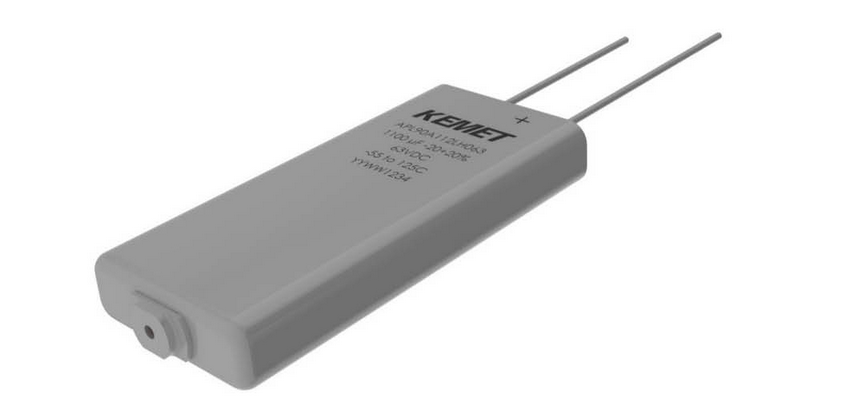
Stacking multiple round electrolytic capacitors next to one another is not the most effective utilization of space. With the APL90 family, Yageo/KEMET provides capacitors with a very compact rectangular housing. This allows for space savings and optimizes thermal management.
Making square electrolytic capacitors is beneficial for many reasons. Firstly, the square housings can be packed more tightly together, thereby reducing the amount of air space lost in automotive or avionics applications.
Benefit number two is that a flat case can be easily connected to heat sinks. This can be useful when dealing with applications that require managing high ripple currents. Its effects, leading to capacitor heat-up, can be mitigated by attaching the capacitor to a heat sink.
63 V- and AEC-Q200-Qualified
Given that 48 V inverters are increasingly popular, Yageo / KEMET opted to certify their capacitors to 63 V. The components are hardy, being able to survive an operating temperature range of --55 to +125 °C and vibrations of up to 20 G. For the 63 V version, the component is certified to withstand surge voltages of up to 72.45 V.
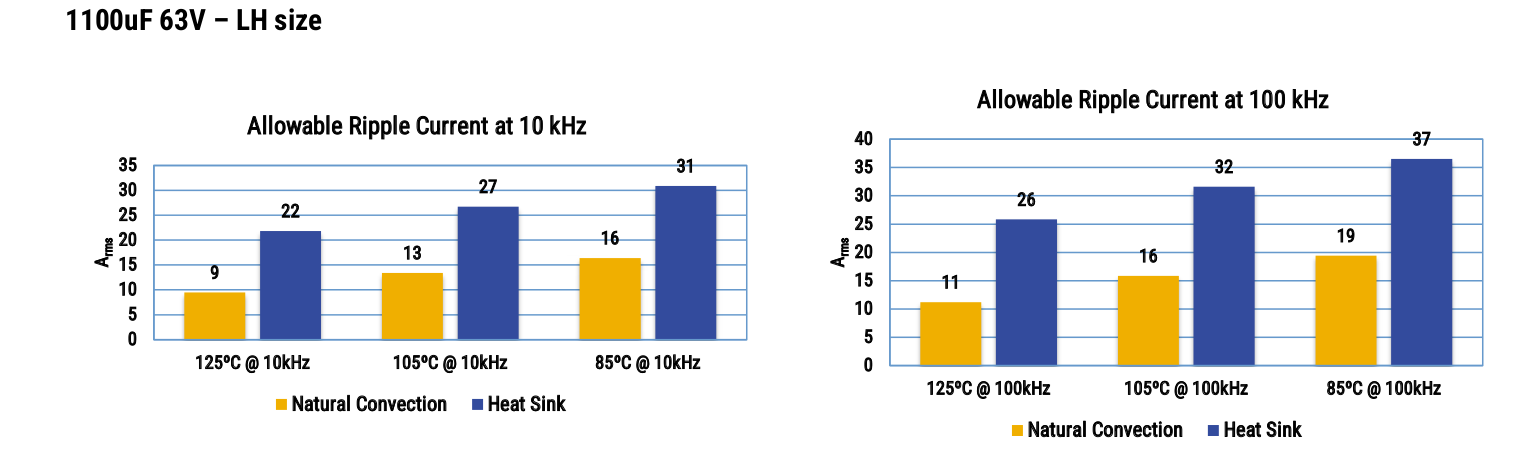
Finally, the current specifications are shown in the figure. Designers need to note that adding a heat sink often doubles the permitted ripple current.
Wide Array of Capacitance and Voltage Options.
The APL90 capacitor family offers a wide range of capacitances and voltages. For example, the 63 V unit with a capacitance of 660 µF can be ordered under SKU APL90A661LF063. If a capacity of 1100 µF is needed, SKU APL90A112LH063 should be specified instead.
For all of the capacitors, a 2000-hour service life is specified at 125°C. Reducing the ambient temperature during operation, of course, can increase this by a factor of multiple decades. Finally, the family's extremely long shelf life deserves commendation. In the data sheet, KEMET provides the following information.
The capacitance, ESR and impedance of a capacitor will not change significantly after extended storage periods, however the leakage current will very slowly increase.
After long periods of storage, it could be a benefit to re-age the capacitors as common practice for Aluminum capacitors.
Leakage current performance is in line with wet and hybrid electrolytic capacitor's behaviour. Leakage current limit is calculated under the same principle.
This is beneficial for certified designs, as a capacitor stockpile can be built up. This way, assembly and procurement become independent of each other.
Conclusion
With its rectangular aluminum-polymer capacitor family, Yageo/KEMET provides designers working on space-challenged designs with a completely new approach to capacitor management. Thanks to stackability and the availability of heatsinks, the components greatly increase the volumetric efficiency of any design. In short, a great innovation in the space of passive components.