Turck IM1-22EX-T - An Explosion-Proof Isolating Switching Amplifier

NAMUR sensors are commonly used as proximity sensors in hazardous or otherwise explosive environments. With the IM1-22EX-T, Turck provides an insulating transceiver that delivers the required currents and safely exfiltrates positioning information from the connected sensors to another system.
The term NAMUR refers to the Normenarbeitsgemeinschaft für Mess- und Regeltechnik in der Chemischen Industrie, which is a German standardization body for sensors and industrial automation in the chemical industry. In principle, a NAMUR sensor is a binary sensor driven by an imprinted current. This means that the sensors' functioning can always be monitored - cable breaks, as well as short-circuits, can be detected because the current will reach specific levels.
In theory, the NAMUR sensor interface works with any binary sensor. In practice, however, they are typically used as proximity sensors to detect the positions of specific process elements in the chemical industry.
Isolating Amplifier for Device Connection
When working on explosive-sensitive chemistry automation projects, keeping the main (non-explosion-safe) process computer away from sensitive chemical areas is usually a good idea. The IM1-22EX-T supports this approach via the architecture shown in the figure below.
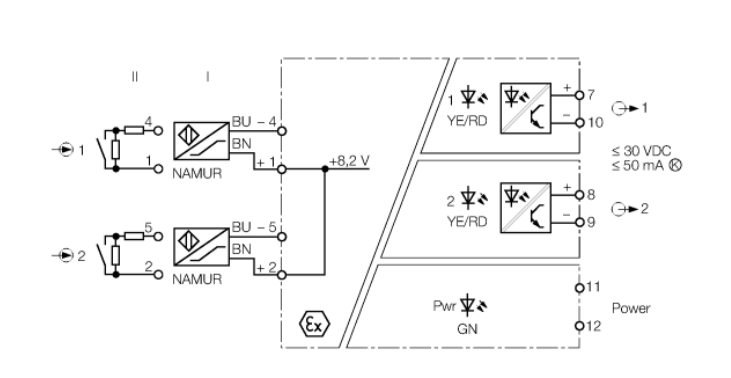
On the left-hand side, the two NAMUR sensors located in the explosion-sensitive area are clearly visible. Across the insulation barrier, a group of photo-transistors can be used to transmit the signal into PLCs, control computers, or similar chemical automation systems.
Front-Panel Switches for Comfortable Configuration
From an optical standpoint, the IM1-22EX-T is DIN rail-mountable. It can operate across a wide range of AC or DC voltages, thereby allowing the system to use voltages already present. This is highly beneficial, as it eliminates the need for an external power supply, which would incur additional costs and require space on the rail.
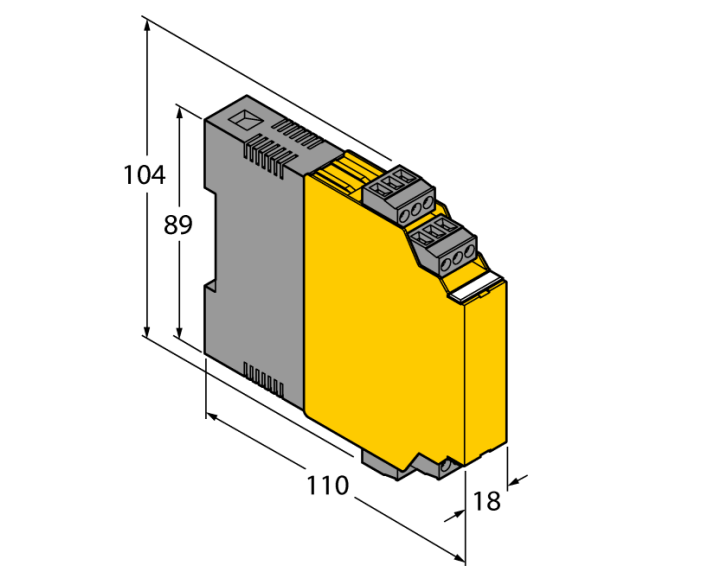
Given that no two sensor applications are the same, Turck provides a set of DIP switches on the front panel. Their layout is shown in the figure below.
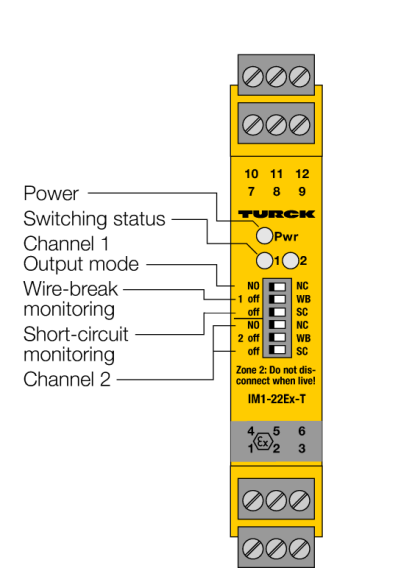
For each of the channels, the protection functionalities - specifically the wire break monitor and the short-circuit monitor - can be switched on or off. Furthermore, three light-emitting diodes provide a glanceable overview of the system's status and the values returned from the connected NAMUR sensors.
Conclusion
If a pair of NAMUR-compliant sensors needs to be monitored in a chemically challenging environment, the Turck IM1-22EX-T is ideally suited to the task. Thanks to its flexible, transistor-based output and its high-level explosion-safety certification, the component makes for a great addition to every electrical engineer's toolbox.