FRDM-MCXW71 - An Evaluation Board for NXP's Bluetooth Wireless SoC
The MCX family combines the various microcontroller projects of the former Philips Semiconductor division. The MCX W series is optimized for applications where wireless protocols such as Matter™, Thread®, Bluetooth® Low Energy, and Zigbee® are used. The FRDM-MCX W71 provides an easy-to-use evaluation board intended to make getting started easier.
Regarding capability, the MCX W family is based on the ARM Cortex-M33 ISA. The various SKUs, namely MCX W71 and MCX W72, differ both in housing and the amount of memory provided. The W72 radio module allows access to the Bluetooth LE channel sounding technology, which can be used to position transmitters in relation to one another.
Visiting the longevity commitment found at https://www.nxp.com/products/nxp-product-information/nxp-product-programs/product-longevity:PRDCT_LONGEVITY_HM reveals that the parts are provided with a 15-year coverage – NXP commits to producing until September 2039.
FRDM-MCXW71 - Get Started Without Soldering
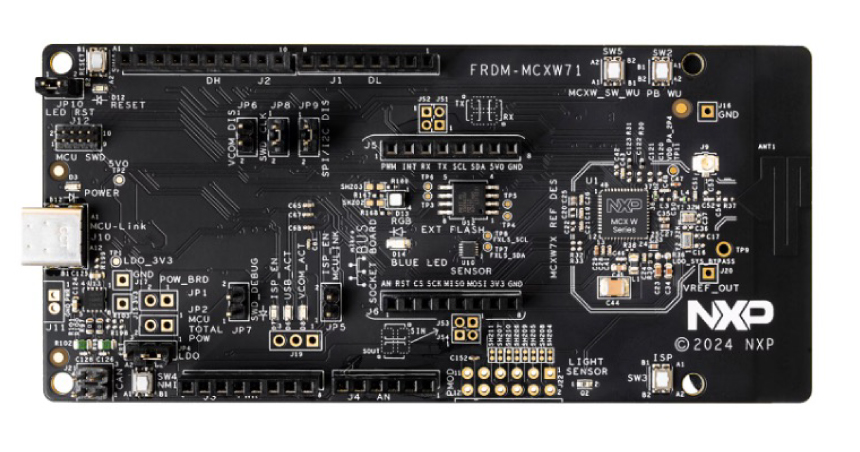
Even though the housings used to house the MCX W microcontrollers are easy to manipulate by hand, having a ready-to-go evaluation board means that embedded software development can start even though the actual hardware has not yet reached the physical prototyping stage. For applications based on the MCX W71, the board shown below is ideally suited.
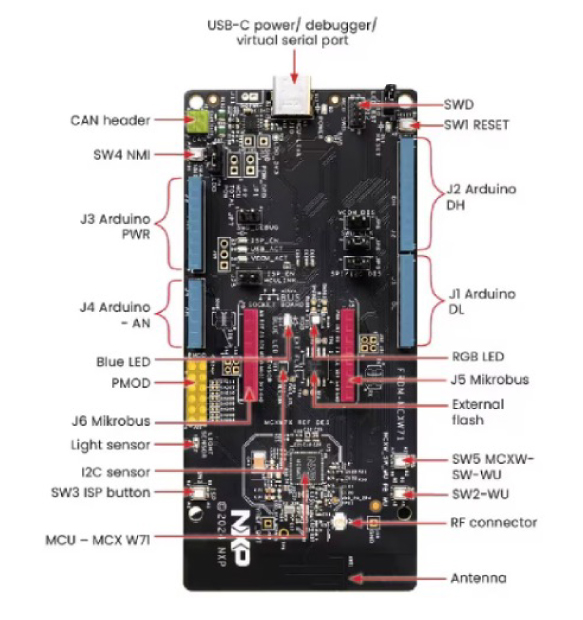
As seen in this detailed board analysis, NXP simplifies adding external hardware via a set of two-connector headers. The header group on the outside is spaced in accordance with the spacing known from classics such as the Arduino, while the inner set of headers implements the mikroBus from MikroElektronika. This means that a variety of boards found on the market can easily be added to the FRDM-MCXW71 board, thereby ensuring simplified software prototyping.
Integrated Peripherals Devices and Debuggers
NXP provides embedded software developers with the choice of two development environments: on the one hand, the classic MCUExpresso is based on the venerable CDT along with accompanying modules. Alternatively, FRDM-MCXW71 caters to developers who prefer to use Visual Studio Code.
In both cases, a USB cable is all that is needed - the FRDM-MCXW71 evaluation board comes with a USB-C port which is connected to an onboard debugging device.
For remanent storage, an MX25R6435FM2IL0 chip is provided and connected to the main microcontroller via the SPI bus - its 8 MB of storage should provide enough space for information. In addition to that, an accelerometer and a light sensor provide for environmental sensing.
Finally, the evaluation board also contains an RGB LED. This can be very useful as a quick status output interface, thereby enabling programs to provide visual information about what is happening inside.
The Freedom Ecosystem for Quicker Development
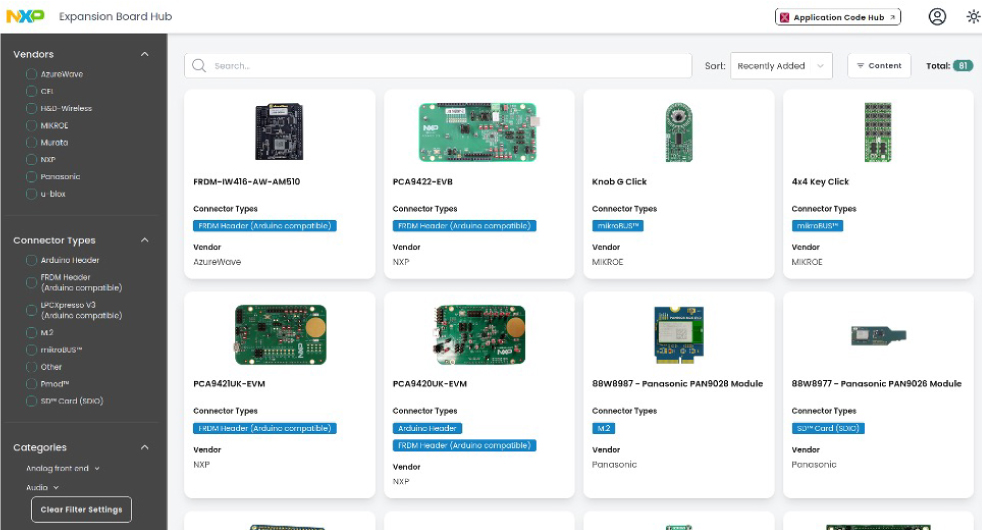
NXP intends the FRDM-MCXW71 to be part of the freedom line. To view the entire family of evaluation boards along with a variety of different devices, simply visit https://mcuxpresso.nxp.com/eb-hub to see an overview of the offerings made available for accelerated prototyping.
Conclusion
If an application based on the MCX W family needs to be prototyped quickly, the FRDM-MCXW71 is ideally suited to the task at hand. Thanks to the generous hardware expansion capabilities, getting started could not be easier.