Digi XBee - A Series Of WiSun Mesh Networking Modules
Mesh networking based on the IEEE 802.15.4g standard is universally accepted in industrial automation. With the XBee family, Digi provides a wide array of easy-to-integrate modules that enable circuits to start communicating in a Wi-Fi mesh network.
Operating in the 900 MHz band, WiSun can deliver data rates of more than 2 Mbit per second. The individual nodes can reach up to 4 km, with meshing enabling them to act as both receivers and amplifiers for devices farther away.
Mesh Networking for a Higher Range
From a technical point of view, a WiSun network presents itself as shown in the figure below.
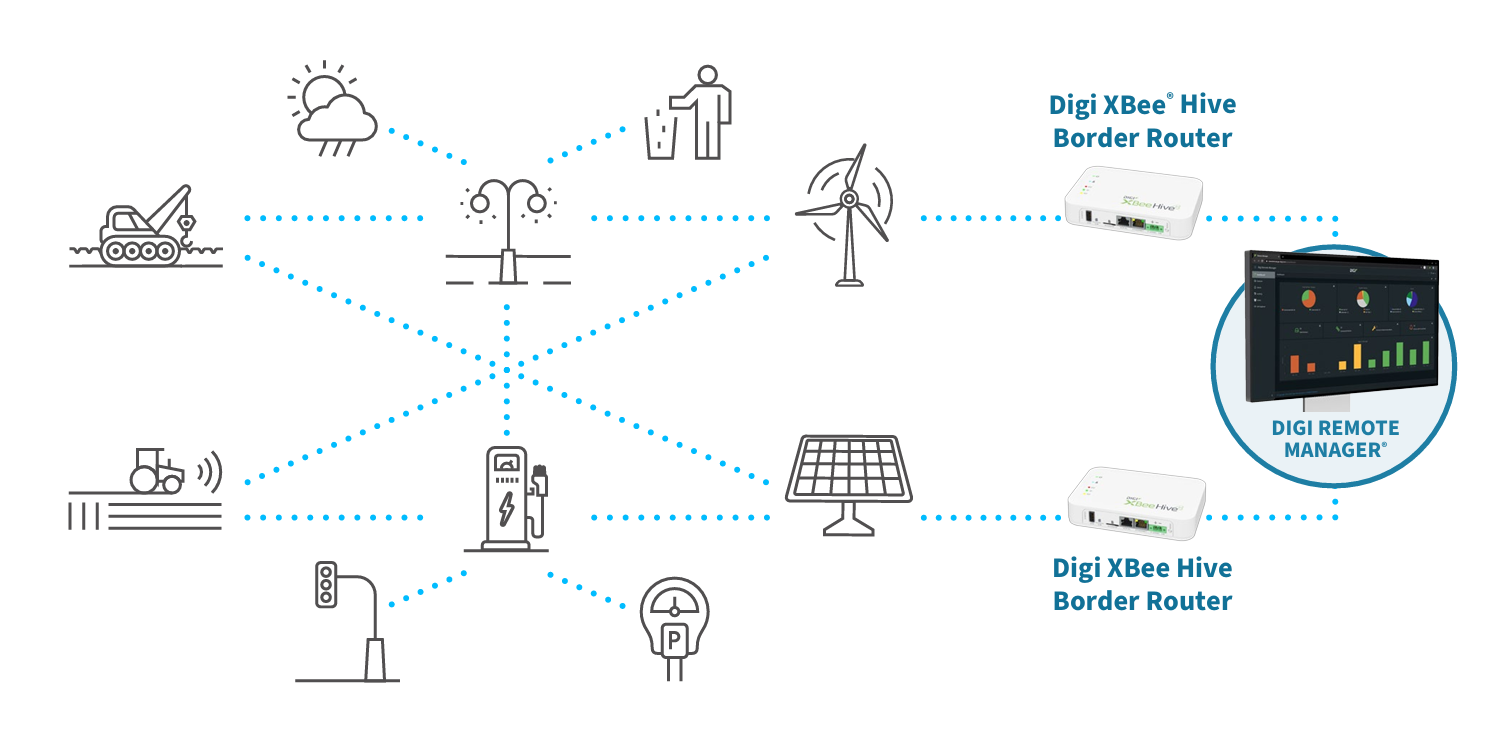
WiSun border routers connect the network to the larger Internet. Individual devices dynamically reconfigure their links to achieve optimal message propagation. The result is that a device far from the border router can still communicate with it, as the other devices act as message relays. The dynamic reconfiguration capability is useful for industrial automation. In practice, propagation conditions can change when large equipment powers on.
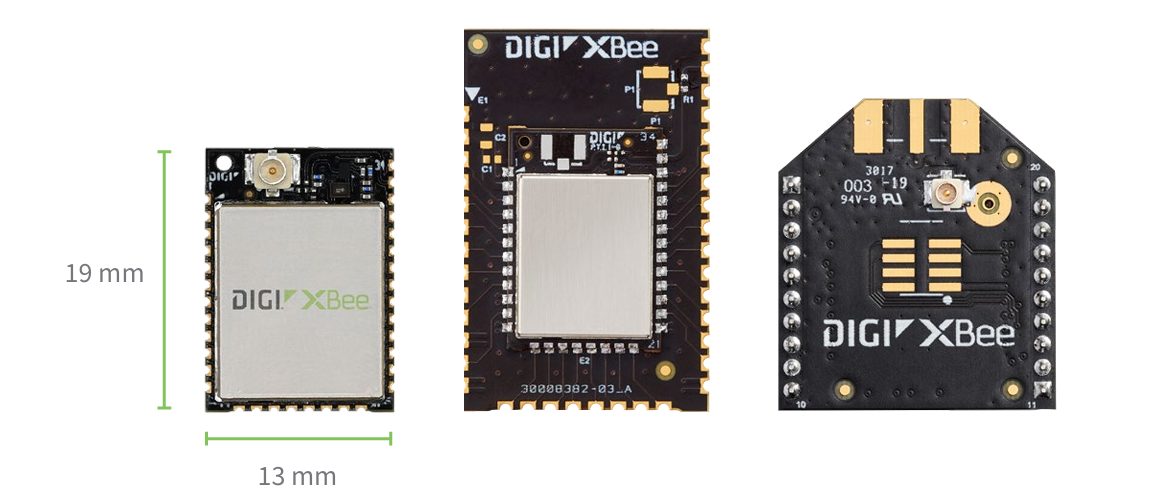
With the XBee family, Digi provides a variety of surface-mountable wireless modems. The three form factors are shown in the figure below; in all cases, the wireless module is to be placed on top of the application PCB.
Various Antenna and Installation Options
Using the 900 MHz band as baseband for WiSun enables the standard to make optimal use of available spectrum in each geography. Every radio zone needs its own module - a WiSun module intended to operate in Europe will not perform optimally in the United States.
Digi International provides three form factors to simplify integration. One of them, being based on the through-hole format, can be exchanged by end users and is ideal for products where WiSun international roaming is useful.
The surface-mount variants differ in their antenna mounting options. Some accept the antenna directly, while others provide an exposed antenna pad. A PCB antenna, easily designed via WiSun antenna matching, can be connected to it via a stripline trace.
Importantly, the pinout of each module family is constant. This means that a WiSun industrial automation device that uses a module for North America can easily work in, say, Japan - switch out the SKU of the wireless module and launch a new production run to finalize geographic adjustment.
For example, SKU XB-WSB-UT-001 corresponds to the through-hole variant intended for the North American market. SKU XB-WSB-UM-001 leads to the-mount module with an u.FL connector, while XB-WSB-RM-001 delivers the version with an exposed RF pad. In the EMEA region, use SKUs XB-WSB-UM-081 and XB-WSB-RM-081.
For all module variants, communication with the host can be done via UART or SPI. This way, microcontroller developers can associate whatever peripheral is suited to act as a WiSun transceiver.
WiSun Routers Are Also Available
Industrial automation engineers building a greenfield solution based on WiSun technology are advised to purchase a router. Digi provides a variety of types. For example, SKU XH-WS8-CE0-001 provides the European version, while XH-WS0-CE0-001 can be used to procure the American edition. All of these come with a variety of value-added services and a Python SDK to simplify getting started.
Conclusion
Mesh networking\'s ability to withstand challenging environmental conditions makes it ideally suited for industrial automation. With the XBee family, Digi provides designers with an easy-to-deploy wireless module family that provides superior RF performance. Thanks to the variety of antenna options, the modules can be deployed without external antenna matching. In short, a highly effective, low-TCO approach for industrial automation networking.