Carlo Gavazzi DPA51 / DPA71 - A Three-Phase Voltage Monitoring Relay

Keeping three-phase machines working requires all phases to be present and properly aligned. With the DPA51/DPA71 family, Carlo Gavazzi offers a product dedicated to monitoring in three-phase systems.
From a form-factor perspective, the entire monitoring relay family is DIN-rail mountable. This means that their installation in panels can be accomplished effortlessly. The sleek dimensions of 17.5 mm for the DPA51 and 35.5 mm for the DPA71 mean that the DIN-rail housings fit even in the busiest of panels.
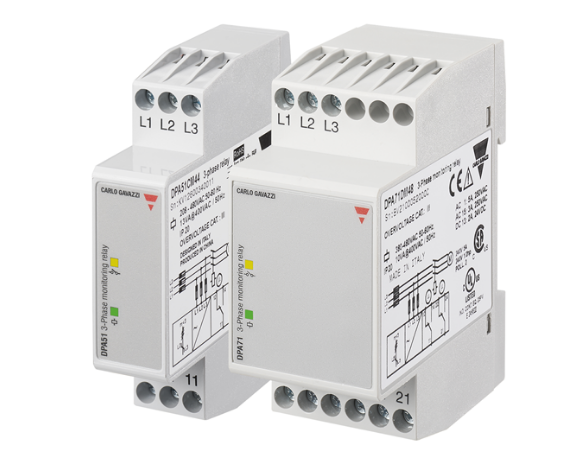
Self-Powering Monitor Solution
The top screw terminals are intended for connecting the relay to the three-phase system that is to be monitored. Power is then drawn from these pins, removing the need for costly external power-supply circuitry.
When integrated into the circuit, the relay monitors the phase sequence and the voltages in relation to one another. This way, the component can perform regenerated voltage detection -- a type of motor protection commonly needed in machines based on three-phase motors. The reason is that a three-phase motor can generate a \"phantom voltage\" on a missing phase, which, however, leads to significantly higher wear.
In total, the following variables are monitored by the rotary current monitor:
- Phase sequence
- Phase loss
- 3P: voltages VL12, VL23, VL31
Special SKUs for Explosion-Sensitive Environments
Carlo Gavazzi provides three versions of this protective relay. The DPA71DM23 is intended for 208 to 240 V AC ±15% (177 to 276 V AC) systems, while the DPA71DM48 operates in a voltage range of 380 to 480 V AC ±15% (323 to 552 V AC). Designers ordering the DPA51CM44 get a slimmer version of the housing, which can save space in busy panels. Finally, HVAC-certified versions are available - their switching process has been modified to be compatible with modern refrigerant chemistries.
Conclusion
If a rotary current system needs to be monitored for safety and reliability, Carlo Gavazzi's monitoring relay family is an excellent choice. Thanks to their capability to detect a wide variety of common and esoteric fault conditions, machine failures can be avoided, and uptime increased.