ASUS Tinker Edge R - A Single-Board Computer Intended For AI Applications
Neural processing units provide significant performance gains for edge-based AI inference tasks. With the Tinker Edge R, ASUS IOT provides a high-performance single-board computer that excels at AI tasks that benefit from hardware acceleration.
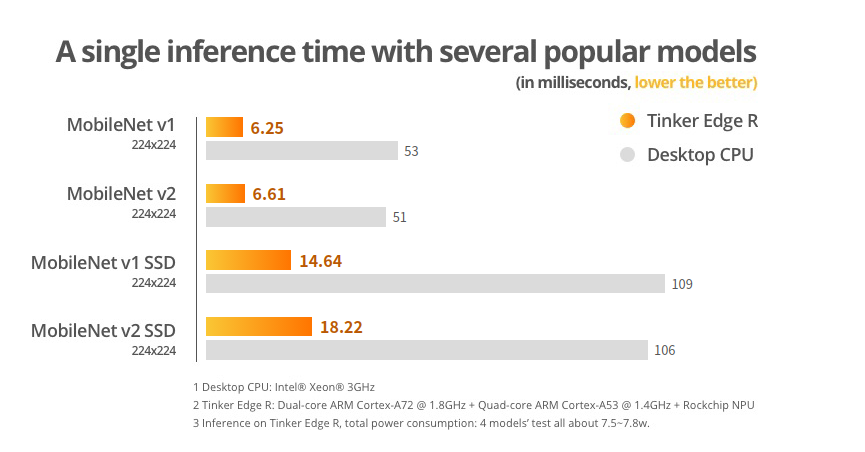
Being based on a RockChip RK3399PRO hexa-core processor, the 90ME00M0-M0EAY0 provides ample compute performance. It is improved via a machine learning accelerator, leading to the inference times shown below. The desktop CPU used in the comparison is a workstation-class Intel Xeon.
The system comes with ample memory. 4 GB of dual-channel DDR4 RAM provide space for the operating system, while the NPU includes an additional 2 GB of sketchpad memory for holding models.
For remanent storage, a 16 GB eMMC module eliminates the need for an external memory card. If required, the card slot uses a push/pull mechanism, which greatly improves vibration robustness in industrial use.
Wide I/O Complement for Effective Data Ingestion
Edge interference tasks profit from the availability of fast, yet flexible interfaces. In the case of the ASUS Tinker Edge R, ASUS provides an enhanced 40-pin GPIO header. It provides the following interfaces:
1 x 40-pin headers includes:
- up to 28 x GPIO pins
- up to 2 x SPI bus
- up to 2 x I2C bus
- up to 2 x UART
- up to 3 x PWM
- up to 1 x PCM/I2S
- up to 1 x S/PDIF TX
- 2 x 5V power pins
- 2 x 3.3V power pins
- 8 x ground pins
For camera data ingestion, CSI interfaces are provided. The supported speeds and specifications present themselves as follows:
1 x 22-pin MIPI CSI-2 (4 lane)
1 x 22-pin MIPI CSI-2/DSI (4 lane)
Finally, the unit has one miniPCIe slot. It is a full-length socket that supports a nanoSIM, enabling direct integration with 4G or LTE communication. A gigabit Ethernet port and a complement of Bluetooth and Wi-Fi transmitters ensure wireless connectivity for this industrial automation single board computer.
Flexible Power Supply Design
Providing power to single-board computers can be an interesting task. In the case of the ASUS Tinker Edge R, ASUS supports designers by offering a wide DC input range from 12 to 19V. On-board switching regulators then convert this voltage, so the current flowing into the single board computer remains low, simplifying connector design.
As for actual power supply, designers can use either a pin header or a classic barrel connector. In both cases, the system permanently monitors supply voltages, ensuring that the board and connected devices are protected from fluctuations.
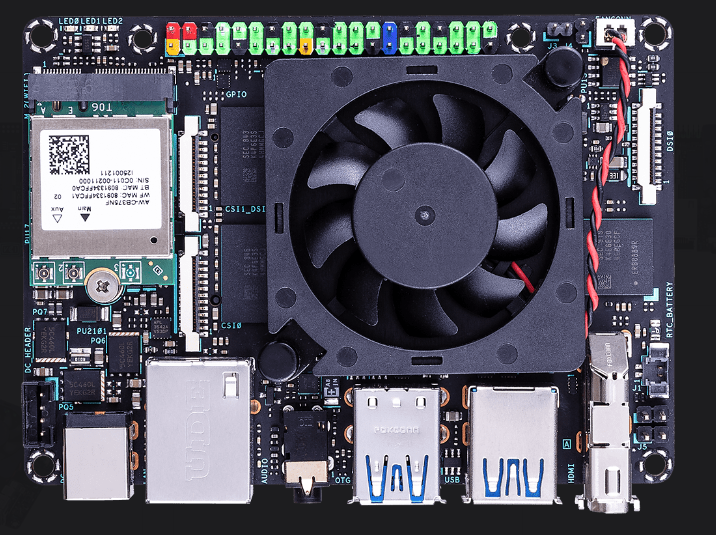
ASUS supports designers working on thermal management, as the board comes with the preinstalled heatsink shown in the figure below.
Comfortable SDK Available
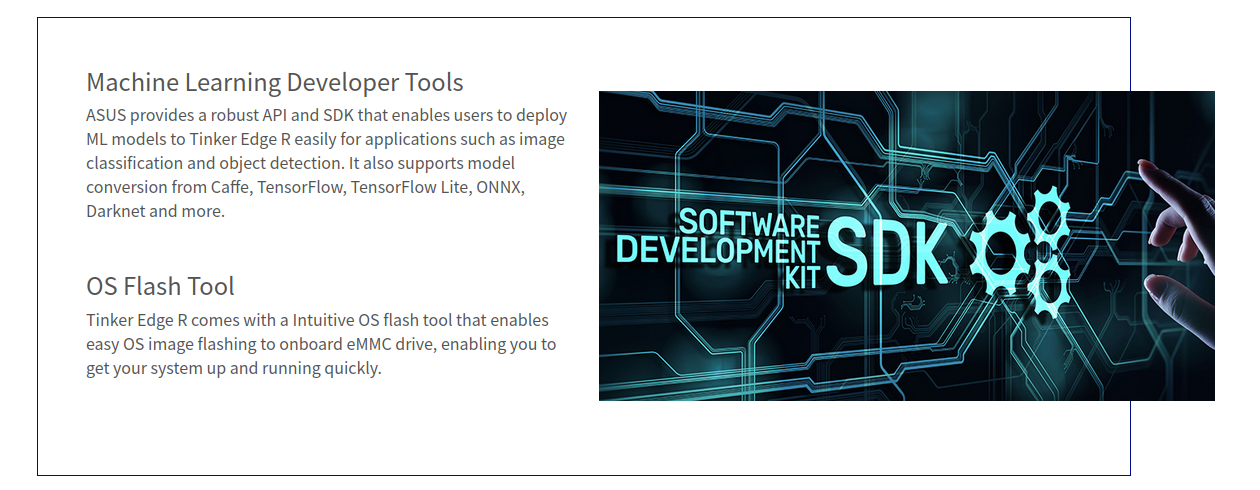
ASUS aids getting started via a variety of utilities and even a fully documented software development kit. More information on these value-added software modules can be found in the figure below.
Conclusion
If an industrial automation design requires a process computer with high compute performance and competent AI acceleration, the ASUS 90ME00M0-M0EAY0 is a prime contender. Thanks to its powerful processor and the excellent documentation, getting started with edge computing is greatly simplified.