Arduino UNO Q - The Arduino Single Board Computer
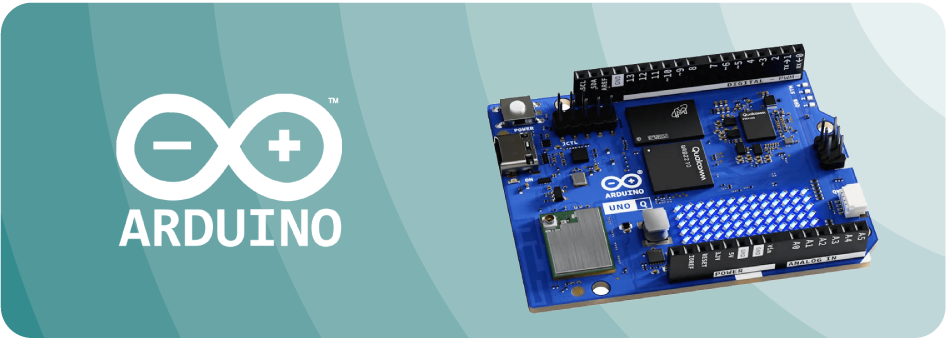
Arduino's latest winning combination contains a Qualcomm Linux SoC and an STM32 real-time core. This way, engineers are ideally positioned to harness the latest developments in embedded systems design and architecture for both AI and traditional control tasks.
The recent acquisition of Arduino by Qualcomm - see https://www.youtube.com/watch?v=ewsM2-_yQbA for further information - provided access to a wide variety of advanced SoC solutions. For the Arduino UNO Q, the QRB2210 will be used.
As shown in the figure below, the System-on-Chip consists of a quad-core ARM Cortex-A53 processor and a Qualcomm Adreno GPU. This means that the Arduino UNO Q is able to run a desktop-like Linux distribution in a manner not dissimilar to the behavior observed on other process computers.
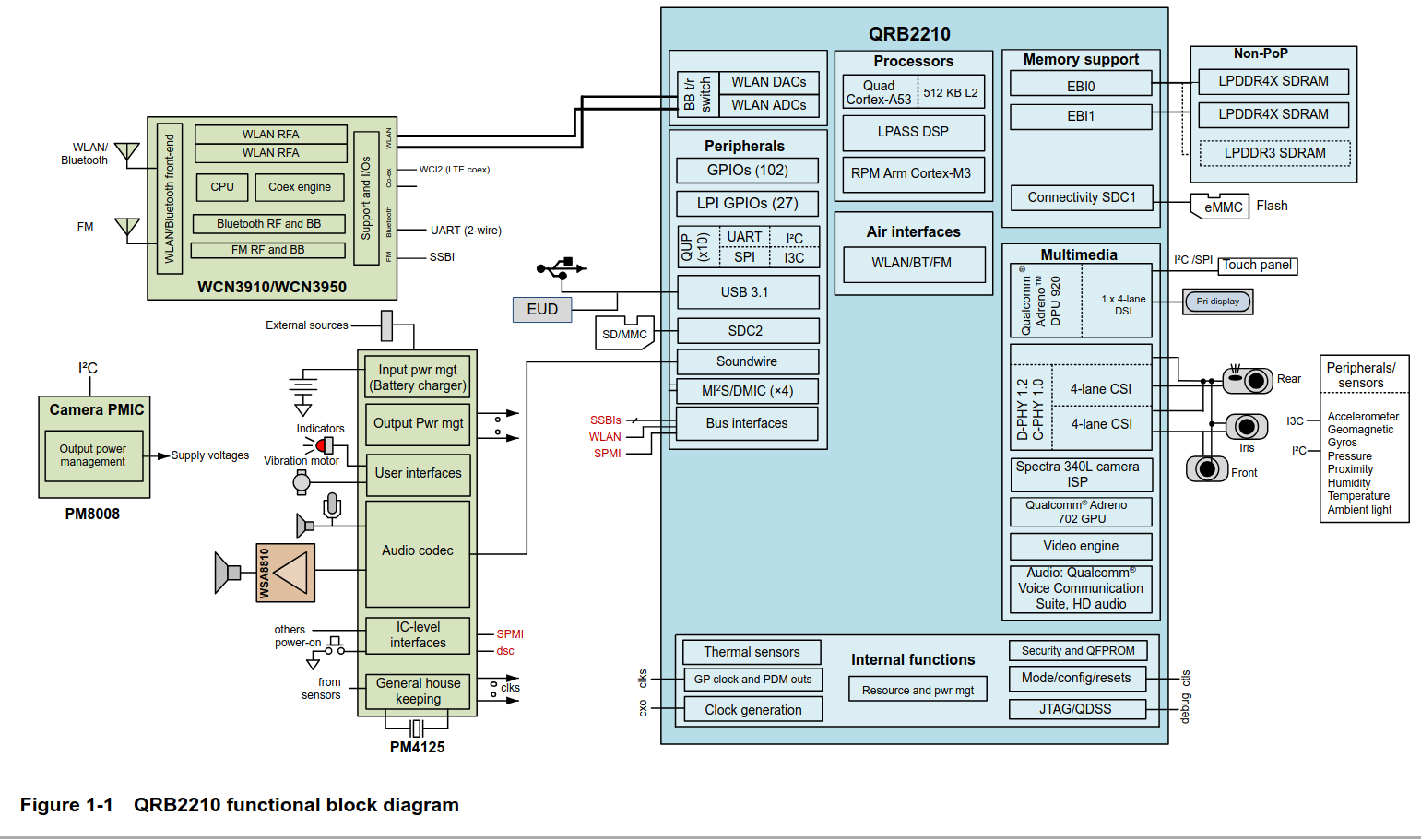
The Arduino UNO Q - commonly known by its SKU ABX00162 - also provides 2 GB of random-access memory and 16 GB of embedded flash memory. As of this writing, a larger, 4 GB RAM version is under active development and should be released soon.
STM32 Technology for Maximum Real-Time Performance
Dedicated microcontrollers are the best choice for designers seeking to provide a guaranteed response time and/or latency. In a fashion similar to the Arduino Yun, the second part of the Arduino UNO Q's compute complement consists of an STMicroelectronics STM32U5 - in particular, SKU STM32U585 is used. It features an ARM Cortex M33 processor that reaches a top speed of 160 MHz and is accompanied by both a DSP and an FPU. These fixed-function units provide significant performance boosts when mathematically complex control or analysis algorithms need to run in real time.
Standalone Process Computer, Arduino IDE Integration, or New-Era Arduino App Lab?
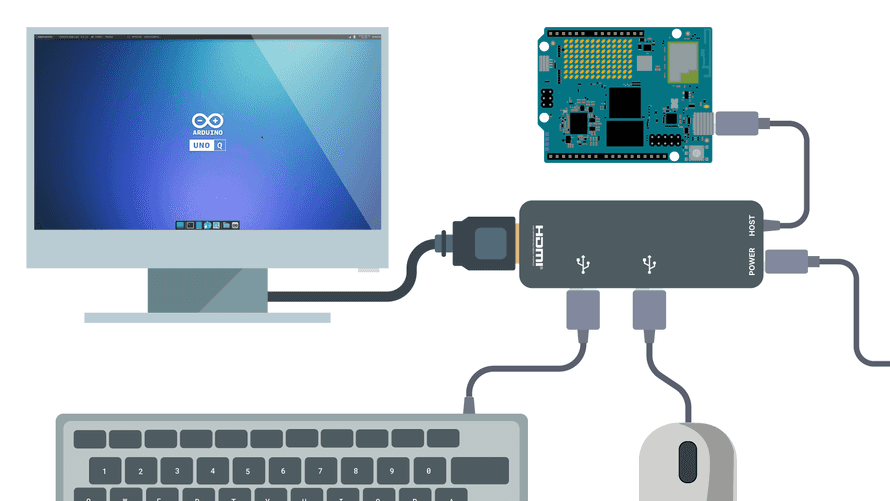
One of the key values of the Arduino platform has always been its role as an enabler for technical innovation. The Arduino UNO Q can work as a standalone process computer - as shown, it provides a USB-C Jack, which is also used for video data output. When paired with a compatible USB hub, the Arduino UNO Q functions as a standalone single-board computer.
Hardware interaction is accomplished via a bridge library which handles data transmission between the Qualcomm and the STMicroelectronics core. A good example of the design patterns involved is found at https://github.com/arduino/app-bricks-examples/tree/main/examples/blink. On the Linux side, the following Python snippet will run:
from arduino.app_utils import \*

import time

led_state = False

def loop():

global led_state

time.sleep(1)

led_state = not led_state

Bridge.call(\"set_led_state\", led_state)

App.run(user_loop=loop)
The bridge library defines a set of mailboxes, which can be used to pass parameters between the compute domains. In the case of our application at hand, we are dealing with a field called \"setledstate\", whose value must be updated by invoking the Bridge.call method.
On the Arduino side, the following sketch will run:
include \"Arduino_RouterBridge.h\"

void setup() {

pinMode(LED_BUILTIN, OUTPUT);

Bridge.begin();

Bridge.provide(\"set_led_state\", set_led_state);

}

void loop() {

}

void set_led_state(bool state) {

// LOW state means LED is ON

digitalWrite(LED_BUILTIN, state ? LOW : HIGH);

}
Its setup method must invoke the Bridge.provide function to ensure that updates to the named string are received. The function takes a function pointer that describes the event handler. As values change, the event handler is called - its job is to adjust the on-board LED according to the desired commands.
Finally, the Arduino UNO Q also makes good use of the virtualization capabilities found in recent versions of the Linux kernel. A new development environment, called Arduino App Lab, provides developers with a set of pre-built bricks that can be arranged in a graphical environment. Some of them contain ready-to-use AI models.
Conclusion
With the Arduino UNO Q, Arduino provides developers with a completely new approach to embedded Linux. If a system requires high-speed GPIO and advanced Linux capabilities, this single-board computer can serve as a one-stop shop.