AD22057 - A High-Quality Amplifier for Signal Conditioning
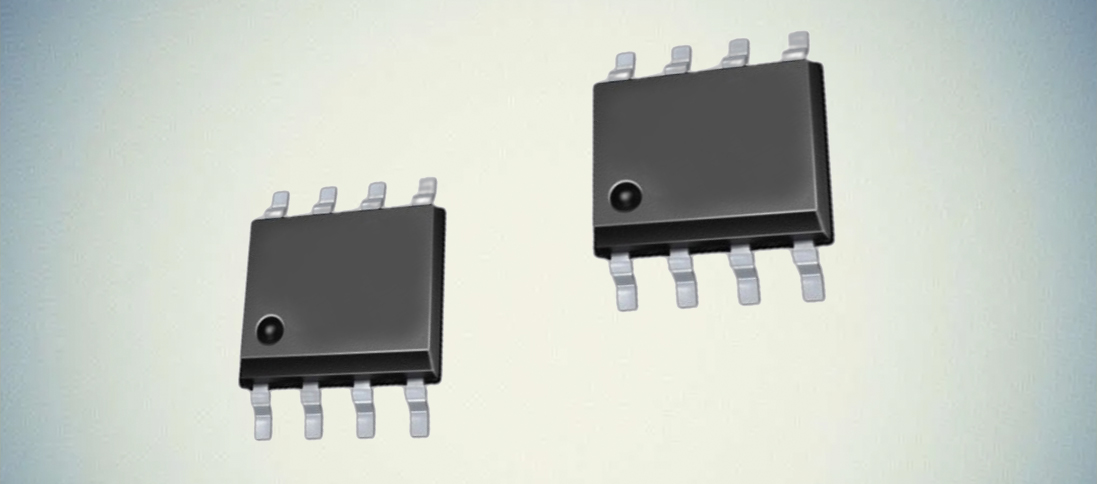
Sensors achieve their noble work through the magic of physics - logic yields that the voltages produced are often quite small. Successful signal acquisition chains usually require the deployment of an amplifier. With the AD22057, Analog Devices provides a chip that also handles a variety of other tasks commonly found in the amplification value chain.
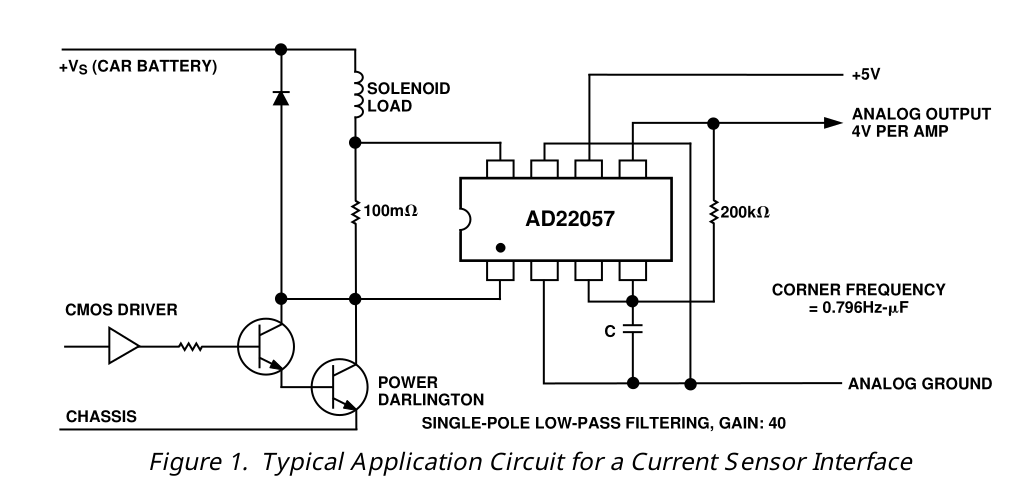
The realities of semiconductor physics dictate that transducers often come with an offset or a common-mode voltage---a good example is shown in the figure, where the voltage across the Darlington transistor should not be part of the measurement process.
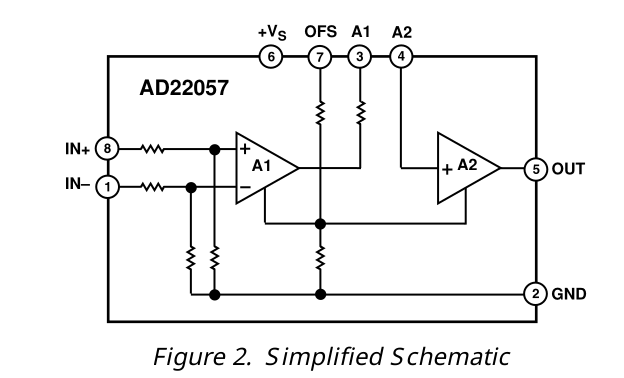
The AD22057 addresses this issue via an integrated differential amplifier: before the actual output is generated, the analog circuitry performs a subtraction operation between the voltages found at IN+ and IN-, thereby permitting the cancellation of external voltages in a highly efficient manner.
 Filtering and
Variable Gain Options for Better Signal Conditioning.
Analog-to-digital converters perform best when the signal utilizes the entire input voltage range. This requires the use of analog signal conditioning before the transition into the digital domain.
In the case of the AD22057, Analog Devices permits circuit designers to use an external resistor network for feedback. An application is demonstrated in the figure below. A potentiometer can be used to adjust the gain applied by the AD22057 to its output signal.
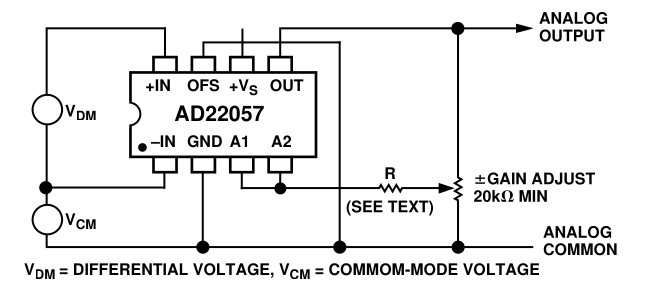
Higher gains of up to 160x are also possible. The high-gain configuration is very similar to the one shown in the figure; however, the use of a highly stable (for example, laser-trimmed) resistor is recommended if high stability of gain is to be maintained in challenging environmental conditions.
Practical attenuation chains benefit from low-pass filtering to reduce the amount of spurious signals present in the output. On the AD22057, Analog Devices provide filtering logic inside the chip. In particular, the AD22057 can mimic the behavior of low-pass filters of the first, second, and third pole order
- This requires but a few passive components and causes minimal increases in PCB space consumption.
Finally, the AD22057 is highly robust in terms of power supply and power output, as it can drive a 1kΩ load to 4V and is capable of handling a reverse supply voltage of up to -34V. Combined with its temperature range of -40 to 125 °C, the component is hardy and predestined for applications where harsh environmental conditions prevail.
Conclusion
If signal acquisition systems require a high-quality instrumentation amplifier, the AD22057 is a no-brainer. Its high performance and the vast array of value-added features permit designers to reduce complexity. In short, it is a component that is always to be recommended.